Life With the Shepherd: What Psalm 23 Really Meant to David
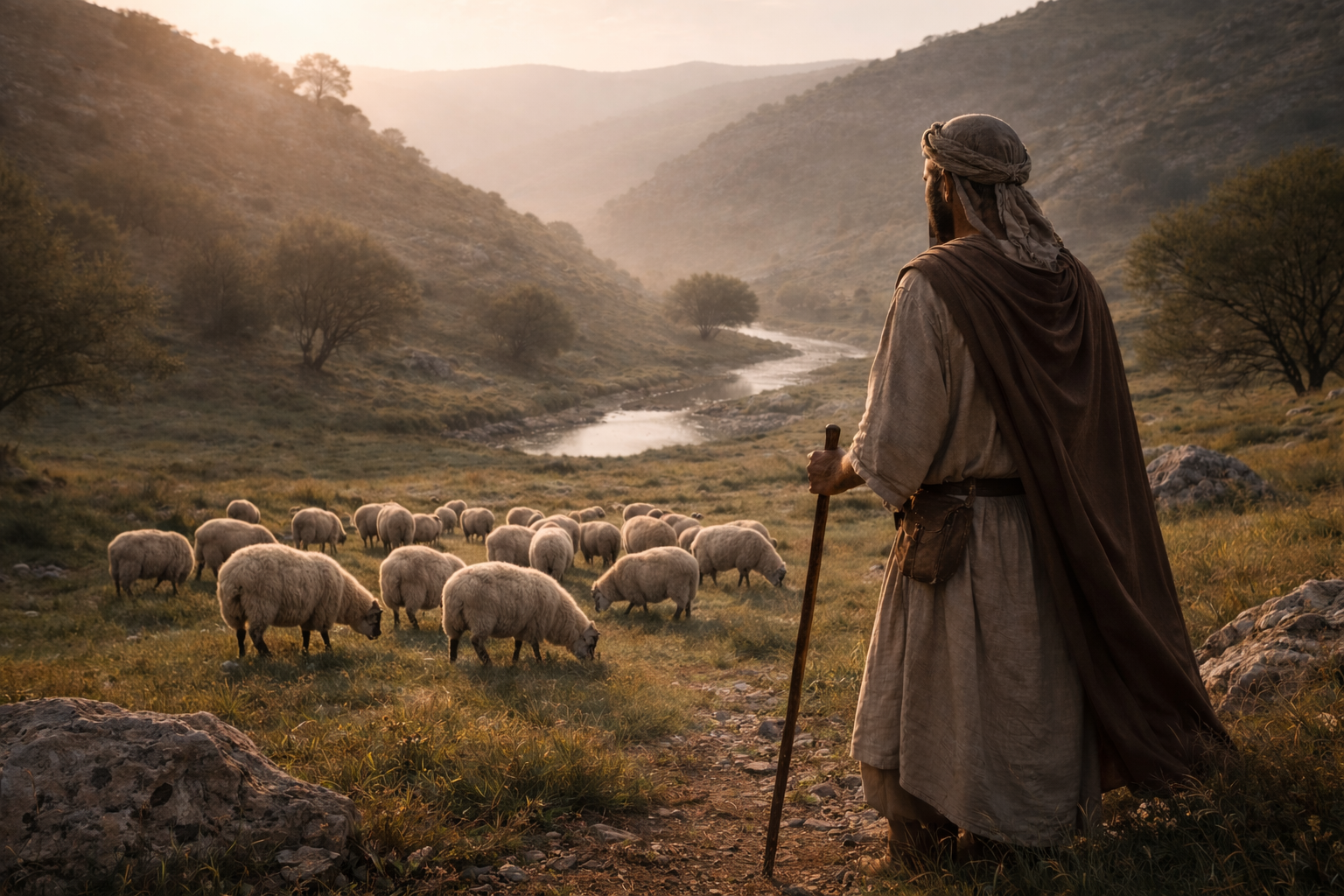
Psalm 23:1–2 Explained Through David’s Life as a Shepherd
Psalm 23 is one of the most quoted passages in the Bible. It is read at funerals, recited in childhood, and often spoken during moments of uncertainty. But sometimes familiarity can cause us to miss depth.
When David wrote Psalm 23, he was not writing abstract poetry. He was writing from lived experience. Before he was king, warrior, or psalmist, David was a shepherd. That matters more than we often realize.
Let’s begin with the text:
“The LORD is my shepherd, I lack nothing.
He makes me lie down in green pastures,
he leads me beside quiet waters.”
— Psalm 23:1–2 (NIV)
These two verses are simple, but they carry layers of meaning that shape how we understand God and ourselves.
David Before the Crown
When we hear the name David, we think of Goliath, kingship, battles, and worship. But Psalm 23 was written by someone who once lived in the fields.
Shepherding in ancient Israel was demanding and dangerous. A shepherd protected sheep from predators, located safe grazing land, found reliable water sources, watched for signs of fear or distress, and lived among the flock day and night.
David did not choose shepherd imagery because it sounded comforting. He chose it because he understood it.
When he says, “The LORD is my shepherd,” he is placing himself in the role of the vulnerable one — a sheep. That is humility.
“I Lack Nothing” — What Does That Really Mean?
The NIV translates verse 1: “The LORD is my shepherd, I lack nothing.”
Older translations say, “I shall not want.” The Hebrew word behind this phrase means “to lack” or “to be without.” It does not mean that David had every desire fulfilled. It means that under God’s care, David would not be abandoned or left without what was necessary.
There is a difference between desire and need.
David had known hunger, danger, betrayal, and uncertainty. Yet he still says, “I lack nothing.” This statement is not rooted in comfort. It is rooted in covenant trust.
Spiritual formation insight: When we say, “I lack nothing,” we are training our hearts to define sufficiency by God’s presence rather than by our circumstances.
Why Green Pastures Matter
“He makes me lie down in green pastures…”
Sheep do not lie down easily. Shepherds have long observed that sheep will not rest unless they feel safe, are free from fear, and their stomachs are full. A sheep that senses danger will remain standing. A hungry sheep will stay restless.
So when David writes, “He makes me lie down,” he is describing a shepherd creating the conditions for rest.
Green pastures in Israel were not endless meadows. They were seasonal and carefully located patches of nourishment. Shepherds had to know the land well.
David is saying: God knows where nourishment is. God knows when I need rest. God knows how to lead me there.
Formation insight: Maturity includes learning to rest where God places you — even when your instincts say keep moving.
The Meaning of Quiet Waters
“He leads me beside quiet waters.”
The phrase “quiet waters” can also be translated as “waters of rest.”
Sheep are cautious around rushing streams. Their wool absorbs water easily. Strong currents can overwhelm them and pull them under. A wise shepherd does not bring sheep to dangerous water sources. He brings them to calm, safe water.
David is revealing something powerful: God does not merely provide water — He provides safe water.
Formation insight: God’s leadership often involves steering us away from environments that look productive but are spiritually overwhelming. Not every opportunity is a green pasture. Not every movement is quiet water. Trusting the Shepherd means trusting His pace.
Reading Psalm 23 Through David’s World
Many Christians read Psalm 23 primarily through a New Testament lens — especially through Jesus’ words in John 10 about being the Good Shepherd. That connection is beautiful and true.
But before we move forward, we must first sit with David’s context.
Throughout the Hebrew Scriptures, God is described as shepherding Israel (see Psalm 80:1; Ezekiel 34). David is not inventing a new metaphor. He is placing himself personally inside a larger covenant story.
When we read Psalm 23 through David’s lived world, we see more clearly that this psalm is about dependence, trust, and formation.
What Psalm 23 Forms in Us
Psalm 23:1–2 shapes three spiritual postures.
First, humility. To call God “Shepherd” requires admitting we are sheep. We are not self-sufficient or all-seeing.
Second, dependence. “I lack nothing” redefines abundance. It challenges us to ask whether God’s presence is enough.
Third, trust in God’s pace. Green pastures and quiet waters are not rushed environments. They are cultivated spaces of nourishment and restoration. Psalm 23 invites us to slow down.
A Quiet-Time Practice
If you want to sit with Psalm 23 this week, try this:
Read Psalm 23:1–2 slowly.
Ask: Where am I resisting being led?
Ask: Where am I drinking from rushing water?
Ask: What would it look like to rest?
Then sit in silence and allow the imagery to shape your prayer.
Living Life With the Shepherd
David’s words were not sentimental. They were survival language from someone who knew what it meant to guard a flock in the dark.
And maybe that is why Psalm 23 still resonates across generations.
We need guidance.
We need protection.
We need provision.
We need rest.
And we need a Shepherd.
If this reflection encourages you, listen to the full episode of Slow 2 Speak — LoFi Friday’s Edition, where we explore Psalm 23:1–2 in greater depth.
Until next time,
Slow down.
Speak truth.
And trust the path God put you on.

Returning to Your Failures: Finding Faith in Defeat